
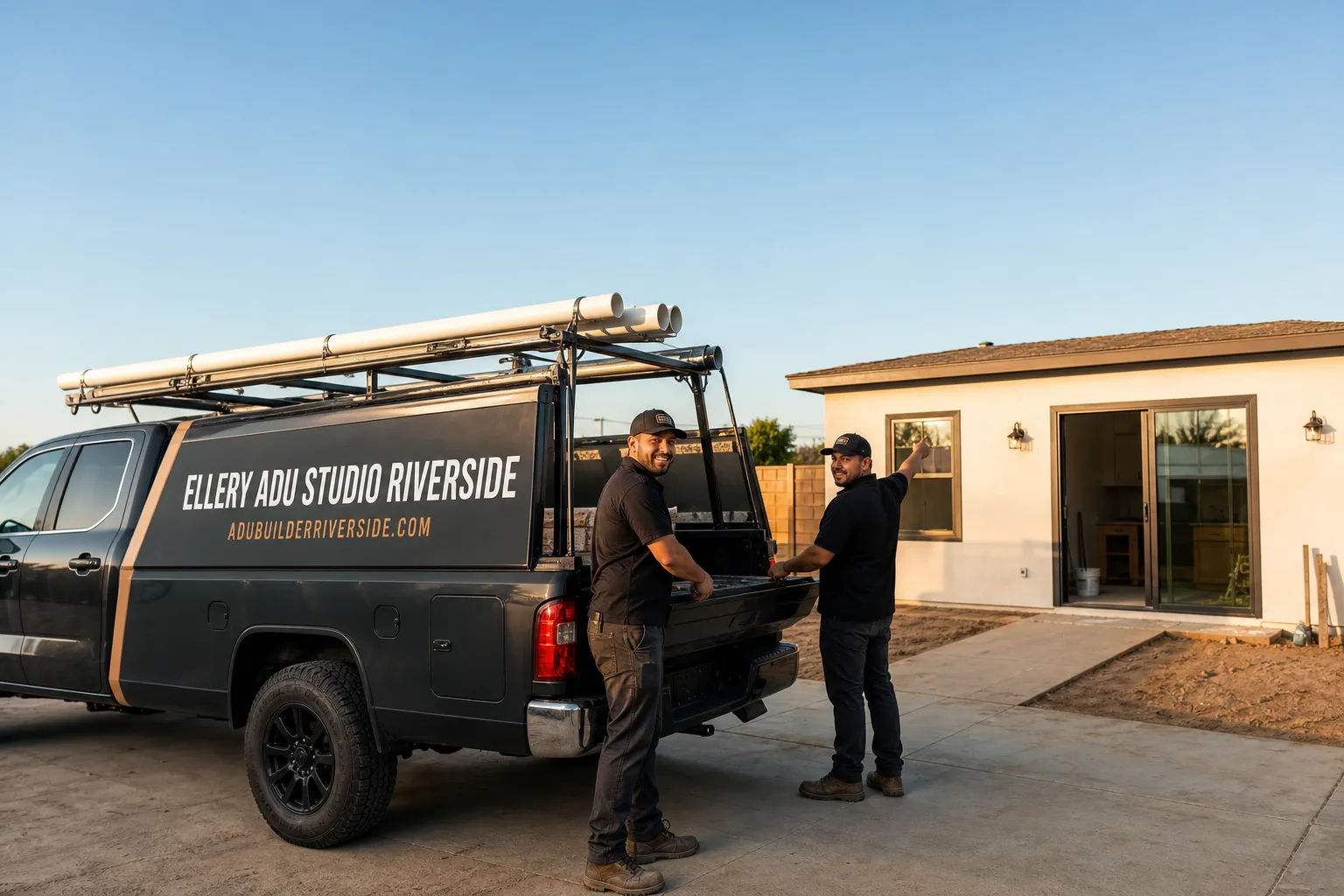
How Much Does ADU Site Prep & Utilities Cost in Riverside?
ADU Site Prep & Utilities services in Riverside, CA typically cost between $18,000 and $65,000, depending on your lot’s existing conditions, how far the utility connections need to run, and whether your site requires grading or soil correction work. Most Riverside homeowners with a standard rear-yard detached ADU land somewhere in the $28,000-$45,000 range once grading, a new electrical panel sub-feed, sewer lateral extension, and water service are accounted for. That range assumes a relatively flat lot with utilities already present at the main structure - two conditions that don’t apply to every property in Riverside’s hillside neighborhoods or older west-side parcels.
ADU Site Prep & Utilities Cost Breakdown (2026)
The table below reflects what Ellery ADU Studio is quoting on active Riverside projects as of early 2026. Every figure here was written before any work started, per Haven Standard Clause 1 - which means these aren’t ballpark numbers pulled from national averages; they’re the written scopes our clients signed.
| Line Item | Typical Riverside Range (2026) | Notes |
|---|---|---|
| Soil report / geotechnical investigation | $1,800 - $4,500 | Required by Riverside Building & Safety on most new detached ADU permits; hillside lots run toward the high end |
| Grading & earthwork | $3,500 - $14,000 | Flat lots in neighborhoods like Canyon Crest or La Sierra run low; sloped lots near Hawarden Hills can double this |
| Sewer lateral extension | $4,200 - $12,500 | Cost scales with distance from main house to ADU footprint; older clay pipe under a concrete driveway adds excavation cost |
| Water service / sub-meter | $2,800 - $7,500 | California AB 2221 allows a shared meter for ADUs under 750 sq ft; a separate sub-meter typically adds $1,200-$2,400 |
| Electrical panel upgrade & sub-feed | $3,500 - $9,000 | Most Riverside homes built before 1990 need a 200A panel upgrade before adding ADU load; SCE interconnect fees are separate |
| Gas line extension | $1,800 - $5,500 | Applies when ADU includes gas appliances; some clients specify all-electric ADUs to avoid this line item entirely |
| Stormwater / drainage improvements | $1,500 - $6,000 | Riverside’s Santa Ana Regional Water Quality Control Board requires on-site infiltration for new impervious surface above certain thresholds |
| Tree removal / root mitigation | $800 - $4,000 | Mature citrus and eucalyptus trees common in older Riverside neighborhoods; root barriers may be required near sewer laterals |
| Compaction testing & inspections | $600 - $1,800 | Third-party compaction testing is often required by Riverside Building & Safety before the foundation pour |
| Permits (site/grading/utilities) | $1,200 - $4,500 | Separate from ADU building permit fees; grading permits in Riverside are tiered by cubic yards of soil moved |
Total combined range: $18,000 - $65,000. The wide spread is real and intentional — we’ve built ADUs in Riverside where site prep was $19,000 because the lot was flat, utilities were close, and the panel was already 200A. We’ve also had projects in the Greenbelt area near the Santa Ana River where grading, a long sewer run, and tree mitigation pushed site prep past $58,000 before a single stud went up. Quoting you a tighter number without seeing your specific parcel would be doing you a disservice.
One thing that reliably moves costs upward: discovering something during excavation that wasn’t visible in the initial site assessment. Old septic infrastructure that wasn’t disclosed, unmarked utility lines, expansive soils (a documented issue in Riverside’s clay-heavy zones near the river basin) — these are the items that cause budget overruns on projects managed without a locked written scope. Under Haven Standard Clause 5 (No Surprises), the scope is locked at signing. If unforeseen subsurface conditions require a change order, you see it in writing before any additional work proceeds.
What Affects ADU Site Prep & Utilities Pricing in Riverside
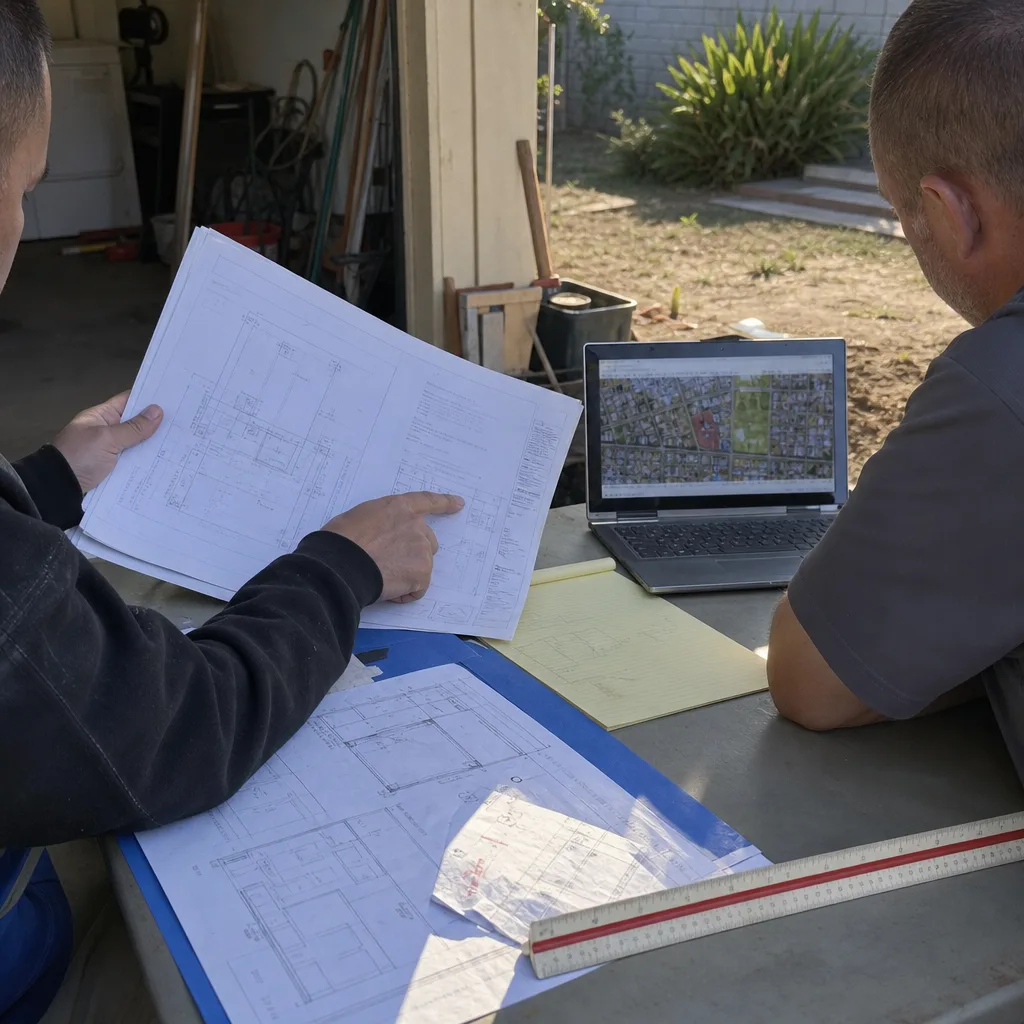
- Lot topography and soil conditions. Riverside sits on a mix of alluvial soils near the Santa Ana River and denser, more expansive clay soils in elevated neighborhoods like Highgrove and Alessandro Heights. Expansive soils require deeper footings and sometimes a post-tension slab, which adds $6,000-$15,000 to foundation costs before site prep is even complete. A geotechnical report — required on most Riverside new-detached ADU permits — tells you exactly what you’re dealing with before the crew mobilizes.
- Distance from existing utilities to the ADU footprint. A 20-foot sewer run from the main house clean-out to the ADU stub costs a fraction of an 80-foot run that crosses a concrete driveway. In established neighborhoods like Wood Streets or University, lots tend to be deep and narrow, meaning longer utility runs are common. Every additional 10 feet of sewer trench adds roughly $400-$700 in labor and backfill.
- Age and capacity of the existing electrical panel. A large share of Riverside homes built between 1955 and 1985 are still on 100A service, which is insufficient to feed an ADU with a heat pump, EV charging, and standard appliances. A 200A panel upgrade from SCE runs $2,800-$5,500 in this market, and it has to happen before the sub-feed to the ADU is sized. Skipping this step isn’t an option — it’s a permit condition.
- Stormwater requirements under the MS4 Permit. Riverside is a co-permittee under the Santa Ana Regional MS4 stormwater permit, which means new impervious surface (your ADU slab, any new hardscape) triggers on-site infiltration or retention requirements above certain thresholds. Depending on your lot size and the ADU footprint, you may need a dry well, bioswale, or permeable paving to satisfy the city’s Low Impact Development (LID) standards. This cost is frequently omitted from rough estimates given to Riverside homeowners — and then it reappears as a change order.
- Existing trees and root systems. Riverside’s older residential neighborhoods — particularly the Victoria Avenue corridor, Magnolia Center, and areas near UC Riverside — have mature tree canopies that are both legally protected and physically in the way. A heritage tree removal requires separate city approval, and root mitigation near sewer laterals adds time and cost. We photograph existing tree locations in the initial site documentation so there are no surprises when the trench crew arrives.
- All-electric vs. gas ADU specification. Specifying an all-electric ADU — heat pump HVAC, induction cooking, heat pump water heater — eliminates the gas line extension entirely, saving $1,800-$5,500 in site prep. The tradeoff is higher electrical load, which may push the panel upgrade cost upward. In most Riverside scenarios we’ve modeled since 2022, all-electric comes out neutral to slightly cheaper on site prep when you net the two line items. California’s building code trajectory also favors all-electric, so the choice has long-term implications for resale.
How to Save on ADU Site Prep & Utilities in Riverside
Know what’s underground before you start designing
The single most expensive mistake Riverside homeowners make is finalizing ADU placement before running a utility locate and getting a soil report. Moving the ADU footprint 12 feet to avoid a long sewer run or to position it above shallower soil can save $8,000-$18,000 before the design is even finalized. At Ellery ADU Studio, site conditions feed directly into the design phase — not the other way around — because we’re designing and building under one contract. That sequencing alone has saved clients material money on projects in the Magnolia Center neighborhood and in La Sierra, where older sewer infrastructure runs in unexpected directions.
Specify all-electric to cut one line item entirely
As noted above, eliminating the gas line extension saves $1,800-$5,500. With California’s Title 24 energy standards already pushing hard toward all-electric, and with Riverside’s summer temperatures making a heat pump’s dehumidification capability genuinely useful, all-electric is the specification we recommend on most new detached ADUs in this market. The panel upgrade cost is real, but it’s offset by the eliminated gas work and by long-term utility rate trends.
Combine permit pulls where the city allows it
Riverside Building & Safety allows — and actually processes faster — when the grading permit and the ADU building permit are submitted as a combined set. Separate pulls mean separate review queues, separate inspection schedules, and more time between milestones. Coordinating a single permit set covering both site work and construction is one of the structural advantages of a ADU Site Prep & Utilities in Riverside scope handled under a single design-build contract: the permit set is written to pull everything together, not handed off between separate firms that schedule independently.
Get a second opinion on any scope already in hand
If you’ve already received a written estimate from another firm, Ellery ADU Studio offers a Free Second Opinion — no obligation, no pressure. Bring the document. We’ll walk through each line item, flag what’s missing (the MS4 stormwater work and tree mitigation are the two most common omissions we see in Riverside estimates), and tell you whether the number is in range for this market. Call (951) 418-2910 and a live person will pick up — not a voicemail queue.
Don’t over-specify the sub-meter if your ADU is under 750 sq ft
AB 2221 permits a shared water meter for ADUs at or below 750 square feet. If your unit is sized at or below that threshold — common for garage conversions and Junior ADUs — skipping the separate sub-meter installation saves $1,200-$2,400. Whether that’s the right call depends on your long-term rental strategy (some property managers prefer a sub-meter for utility billing purposes), but it’s a legitimate cost lever worth discussing during scope development.
Sequence the panel upgrade to serve both the ADU and any planned EV charging
If you’re planning to add Level 2 EV charging — for the main house or the ADU — a panel upgrade you’re already doing for the ADU is the most cost-efficient time to rough in that capacity. Adding a 50A EV circuit during an already-open panel upgrade typically costs $400-$900 in incremental labor. Coming back to do it separately after construction is complete runs $1,800-$3,500. This is the kind of sequencing detail that a single-contract design-build model handles automatically because the electrician is already coordinated into the timeline.
FAQs: ADU Site Prep & Utilities Cost in Riverside
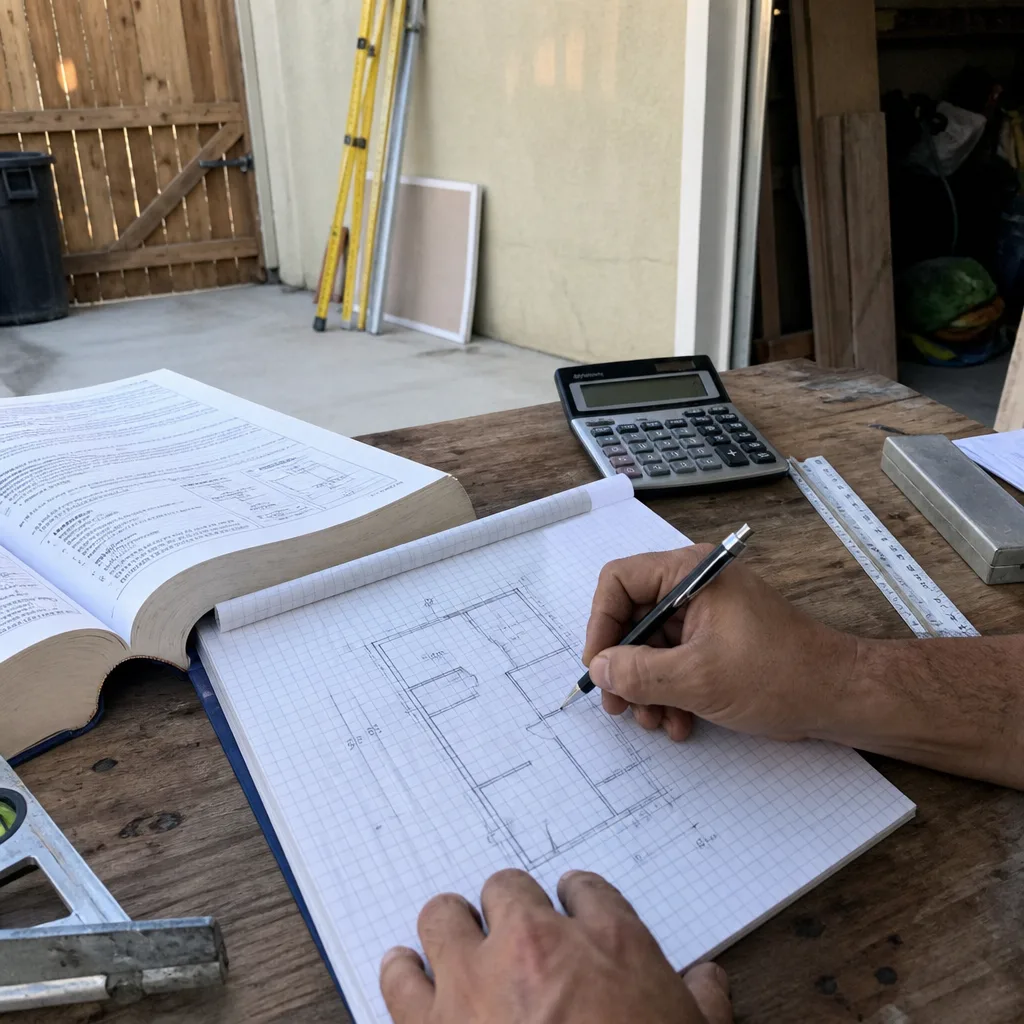
How much does ADU site prep cost in Riverside, CA?
ADU site prep in Riverside typically costs $18,000-$65,000 for a new detached ADU, with most standard rear-yard projects landing between $28,000 and $45,000. That range covers grading and earthwork, sewer lateral extension, water service, electrical panel upgrade and sub-feed, and permit fees. Garage conversions and Junior ADUs run lower — often $12,000-$22,000 for the utility and site work portion — because the slab and utility rough-ins are already partially in place. If you have a written scope already, call (951) 418-2910 and we’ll review it for free.
Does Riverside, CA require a geotechnical (soil) report for an ADU?
Yes, in most cases. Riverside Building & Safety requires a geotechnical investigation report for new detached ADUs, particularly on properties that haven’t had recent grading or construction. The report costs $1,800-$4,500 depending on the number of borings required and the complexity of the site. Hillside properties in neighborhoods like Hawarden Hills or Alessandro Heights regularly require deeper investigation and, as a result, costlier reports. The data in the report directly determines footing depth, foundation type, and slab specification — so it’s an early spend that prevents much larger late changes.
Can I use my existing sewer lateral for a new ADU in Riverside?
Sometimes, but it requires a capacity verification. Riverside’s municipal code allows connection to the existing lateral if it can be demonstrated that the pipe size and slope are adequate for the added load. An older clay pipe, a lateral that’s already at or near grade, or a run that’s been root-infiltrated (common in the Wood Streets and University neighborhoods where mature trees are dense) will typically need to be partially or fully replaced. The assessment happens during the permit review process, and the cost of extension or replacement — $4,200-$12,500 in this market — needs to be in your written scope before construction begins. Ellery includes this verification in the initial site documentation so the number is settled, not estimated, by the time you sign.
How long does ADU site prep take in Riverside?
For a standard new detached ADU with no significant soil issues, the site prep phase — grading, utility trenching, inspections, and slab prep — typically runs 3-6 weeks in Riverside. That timeframe assumes permits are already in hand; permit processing at Riverside Building & Safety has ranged from 6-14 weeks for new detached ADUs depending on plan check queue depth and whether the application is complete at first submission. Incomplete submittals are the primary cause of delays, which is why the permit set is the core product at Ellery — 900+ permit sets submitted since 2015, documented and photo-recorded at every milestone.
Is ADU site prep included in the total ADU cost, or is it separate?
At most ADU contractors in Riverside, site prep is either quoted separately or excluded from the main ADU price, which is how “all-in” prices of $120,000 become $160,000 by the time the permit is pulled. At Ellery ADU Studio, site prep and utilities are one of the five service categories covered under the single-contract design-build model, with a written price before any work starts per Haven Standard Clause 1. The number you sign is the number you pay, with change orders only triggered by documented unforeseen subsurface conditions — and those are disclosed in writing before any additional work proceeds. If you want to see what that looks like in practice, the home page outlines the full scope of what’s covered under one contract.
What is the most common hidden cost in Riverside ADU site prep?
Stormwater compliance — specifically the Low Impact Development (LID) requirements tied to Riverside’s MS4 permit — is the line item we most often see missing from competitor quotes. When new impervious surface exceeds the city’s threshold, you’re required to either reduce runoff or provide on-site infiltration. A dry well installation typically costs $3,500-$8,000. A bioswale runs $2,500-$6,000. Neither shows up in the “rough estimate” a homeowner gets from a contractor who isn’t also the designer. The second most common omission: the panel upgrade. If your main house is on 100A service, the upgrade is a permit condition for the ADU electrical sub-feed — not optional, and not something that comes after the ADU is built.
What Ellery ADU Studio Puts in Writing Before Any Shovel Moves
Nadia Ellery started Ellery ADU Studio in 2015 because the standard ADU process in Riverside left homeowners with two separate contracts, two separate points of failure, and no single party responsible when the grade was off or the sewer stub wasn’t where the drawings said it would be. The design-build model exists specifically to close that gap.
On every site prep and utilities scope, here is what is documented before the first mobilization:
- A written price covering every line item listed above — no “allowances” substituted for real numbers
- A site photo record of existing conditions: panel location and amperage, sewer cleanout location and estimated pipe condition, tree inventory with dimensions, grade elevations at the ADU footprint corners
- A permit set that includes the grading plan, drainage plan, and utility connection details, prepared by Ellery’s licensed design team as part of the single contract
- The 365-Day Done Right Promise in writing: if the finished work doesn’t match the permitted drawings, Nadia Ellery’s team corrects it at no additional charge
We’ve delivered this documentation on every one of the 900+ ADU projects we’ve designed, permitted, and built in and around Riverside since 2015. It’s not a pitch — it’s how the process runs, written into Haven Standard Clause 1 and backed by Clause 5 (No Surprises). The scope is locked at signing. What you see is what you pay.
If you’re early in the process and want to understand what site prep will realistically cost for your specific parcel — including neighborhoods like Orangecrest, Canyon Crest, Mission Grove, La Sierra, Arlanza, or any of the hillside areas — call (951) 418-2910. A live person will answer. Bring any written estimate you’ve already received; the Free Second Opinion is available on any documented quote, no strings attached.
Key Takeaways
- ADU site prep and utilities in Riverside cost $18,000-$65,000, with most standard projects landing at $28,000-$45,000
- The four largest line items are grading/earthwork, sewer lateral extension, electrical panel upgrade, and water service — each with wide ranges driven by lot-specific conditions
- Riverside’s MS4 stormwater requirements and geotechnical report obligations are permit conditions that frequently get omitted from early-stage estimates
- All-electric ADU specifications eliminate the gas line extension ($1,800-$5,500 savings) and are aligned with California’s Title 24 trajectory
- A written price before any work starts — Haven Standard Clause 1 — means the number you sign is the number you pay
- Ellery ADU Studio has operated as a single-contract design-build practice in Riverside since 2015; Nadia Ellery leads every project with a permit set as the core deliverable, not an afterthought
- A Free Second Opinion is available on any written estimate already in hand — call (951) 418-2910
Pricing reflects the Riverside market as of 2026. Ellery ADU Studio Riverside offers free estimates — call (951) 418-2910.
Written by Nadia Ellery, Owner at Ellery ADU Studio, serving Riverside, CA since 2015.
What Our Customers Say
"The permit set and the build were one contract with one number. Our neighbours used two firms and spent a year watching them blame each other."
- Helena V."Every allowance was itemised at the start, so the finish selections did not turn into a surprise at the end."
- Benedict H."Handled the whole planning process. We went to one hearing and that was it."
- Rowena C.